

Urban oases on sidewalks
Gladiola Camacho Díaz, in Urban oases on sidewalks, we are invited to reflect on the importance of micro-gardens in a context dominated by harsh urban landscapes. These spaces represent small-scale interventions that evoke the appropriation and lived experience of the urban environment by its inhabitants.
In many Mexican cities, walking means moving through harsh landscapes: sidewalks without shade, streets without trees, and continuous walls that fragment the urban experience. Contemporary housing, increasingly enclosed and standardized, has gradually erased intermediate spaces, eliminating patios, entryways, and inhabitable thresholds. In their place, walls, inert surfaces, and a growing sense of disconnection have remained.
However, amid this homogenization, small forms of resistance emerge.
The micro-gardens that appear on sidewalks, at home entrances, or along narrow frontages are much more than an accumulation of pots: they are deeply human gestures that reconfigure the relationship between the home and the street. They are almost always born out of a lack —the absence of a patio or a garden of one’s own— but they become a statement: if there is no space, it is invented.
Urban micro-gardens are small green spaces that counteract the aridity of the urban landscape and bring vitality to the built environment.
Urban micro-gardens are small green spaces that appear on sidewalks, in front of homes, on narrow front yards, and on balconies, helping to counteract the barrenness of the urban landscape.
In this way, the sidewalk ceases to be merely a thoroughfare and becomes a territory: a space that is claimed, inhabited, and cared for.
These gardens do not follow academic rules or controlled palettes. Within them, diverse species coexist without hierarchy: plants that have been inherited, exchanged, or rescued. They are living collections that grow, change, and overflow over time. They do not seek formal perfection, but rather the continuity of care. As Gilles Clément proposes, the garden can be understood as a space where one seeks to do “as much as possible with nature and as little as possible against it.”
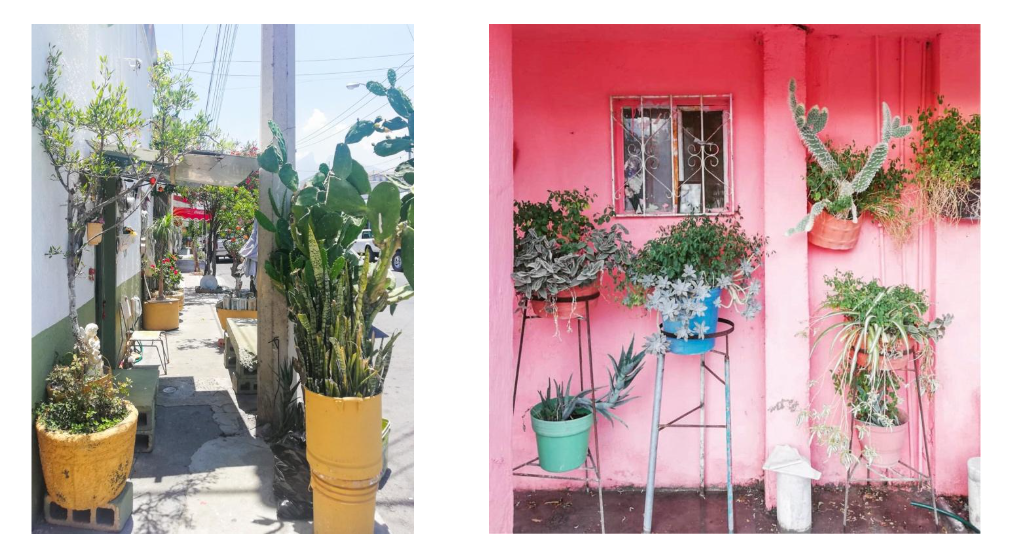
Fotografía izquierda: Pasillo amarillo densamente habitado /Left photography: High-density yellow corridor
Fotografía/Photography: Gladiola Camacho
Fotografía derecha: Banqueta rosa con instalación jardín /Right photography: Pink sidewalk with garden installation
Fotografía/Photography: Gladiola Camacho
However, their potential is not limited to the vegetal, but lies in what they provoke.
In streets where everything is repetitive, these micro-gardens burst forth like urban surprises. The pedestrian walking among arid surfaces suddenly encounters a small botanical universe: colors, textures, and life in motion. There is something profoundly moving in that unexpected encounter, in that appearance that wasn’t designed for spectacle, but for everyday life.
These spaces function as true urban oases, not only because of the presence of plants, but because of what they offer: shade, humidity, refuge for insects and birds, as well as pause, intimacy, and a sense of shared care. They are small breaths within the city, fragments where the human scale reappears.
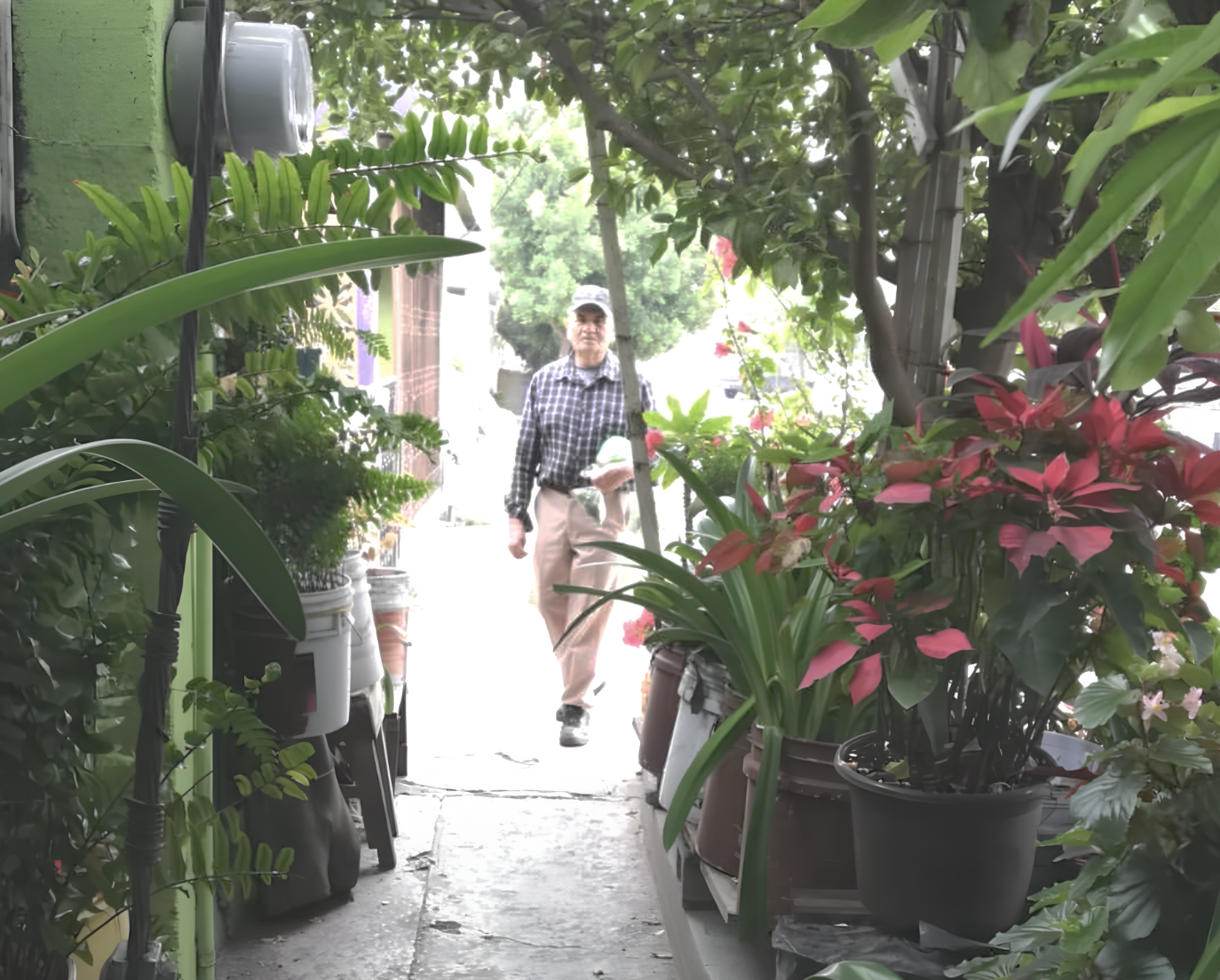
Mi jardin es para todos / My garden is for everyone
Fotografía/Photography: Gladiola Camacho
At the same time, they evoke a cultural memory. They recall the Mexican zaguán, that intermediate space that offered hospitality to passersby: a bench, a fountain, a place to pause. Contemporary microgardens, though more modest, recover that gesture of openness. They do not isolate the home; they expand it.
We could understand them as a “lobby of nature”: a living threshold that softens the transition between the domestic and the urban. For those who inhabit them, they are an emotional extension of the home; for those who pass through them, they become an unexpected experience that transforms the journey.
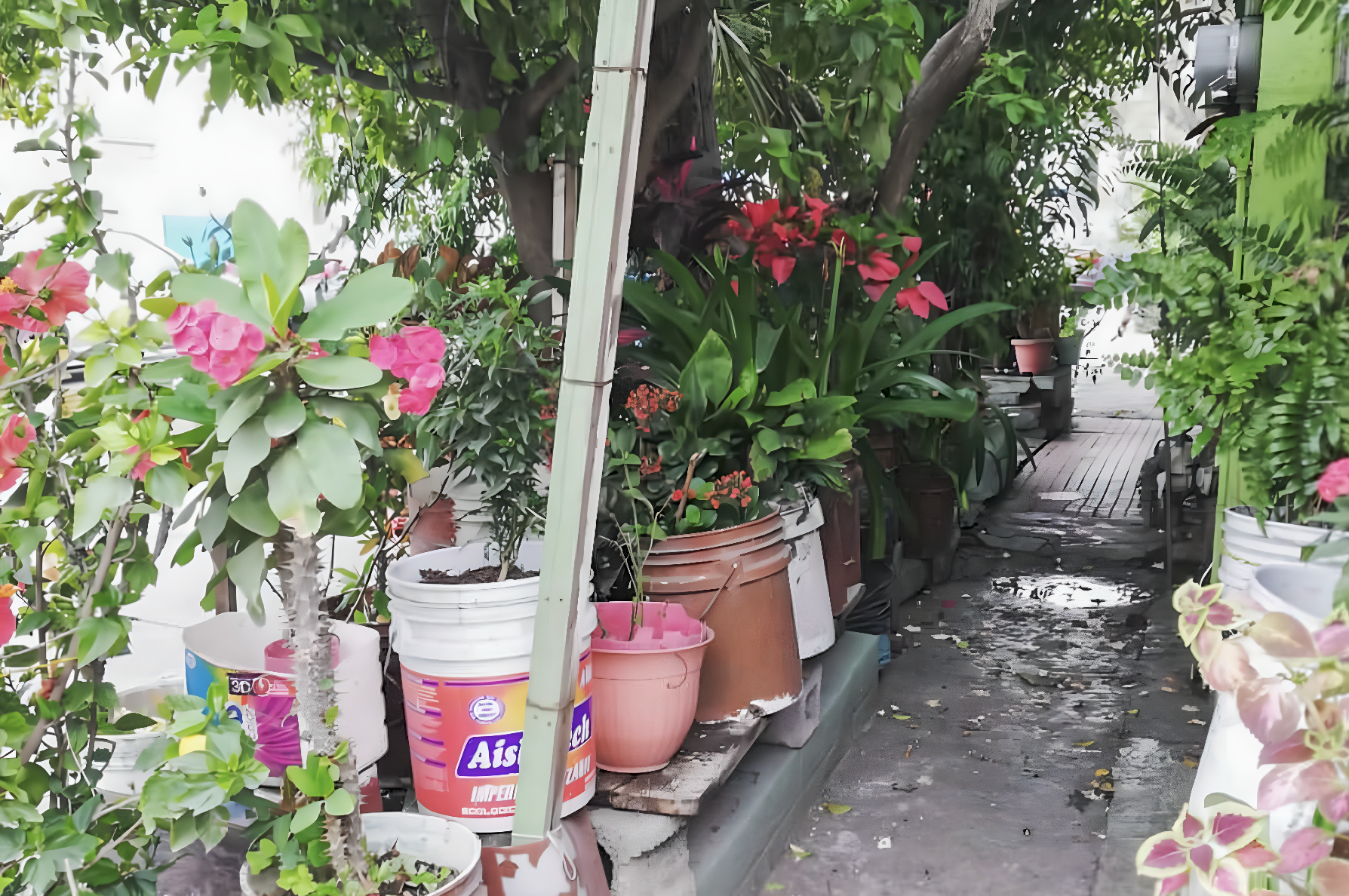
Pasillo densamente habitado/ High-density corridor
Fotografía/Photography: Gladiola Camacho
In a context where the city tends toward uniformity, these gardens are acts of silent resistance. They resist the logic of standardization, the disappearance of the everyday, and the idea that public space does not belong to us.
And, above all, they remind us of something essential: that landscape is not always designed from above. Sometimes, it emerges from below, from the domestic realm, from the simple — yet profoundly transformative — desire to make life flourish even in the most unlikely spaces.
Semblanza
Gladiola Camacho Díaz, is an architect with a master’s degree in Landscape, Heritage, and Territorial Studies. She directs Gladiola Landscape Studio, a firm focused on designing spaces that integrate ecological sensitivity, foster biodiversity, and promote the social appropriation of the landscape. Her work seeks to reconnect people with nature through interventions that combine environmental, cultural, and aesthetic value. She is a member of the Mexican Society of Landscape Architects (SAPMX).


-10.28.24.jpg "Anunciate07-13-a-la(s)-10.28.24")

 13.26.42.png "Captura de Pantalla 2023-02-08 a la(s) 13.26.42")