
It’s uncomfortable for me, but good for nature
In her article “It’s uncomfortable for me, but good for nature,” Mariana Pinto shows us how winter changes the rhythm of the park while coexisting with the conservation of a valuable urban ecosystem, raising an urgent question about safety without sacrificing biodiversity.
Places do not have a single identity, but multiple ones. They are interpreted in diverse ways, depending on who observes them, their historical, social, and cultural context (Massey 1994). With these words in mind, three weeks after settling in Brussels, I set out to explore Duden Park with five Belgian women, neighbours of the area, who visit it regularly during the winter.
Duden is nestled within a middle-class residential area in the southwest of the city. Surrounded by tall trees (beech, chestnut, maple, and ash) and an orange carpet of fallen leaves, we met for a walk. This exercise helped us to recognise our physical presence in the park: to activate our senses (Ingold, 2004) and, by doing so collectively, to exchange sensory and social experiences along the way (Pink, 2008).
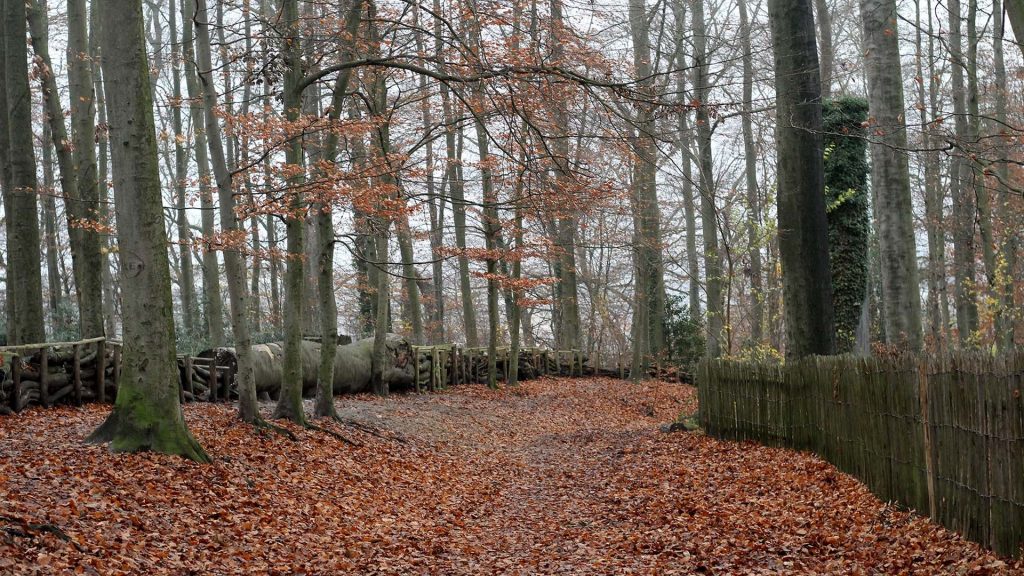
Corredor para perros sin correa / Off-leash dog trail
Fotografía: Mariana Pinto
Among the variety of paths that rise and fall toward two landscaped open areas, we talked about the possibilities Duden offers: physical activity (running, walking, or walking dogs), socialising (spontaneously or in select groups), or simply enjoying the surroundings. But as the sun sets, the rhythm changes.
According to them, winter exacerbates a series of persistent conditions that limit their time and enjoyment of Duden: the days are shorter, and the uneven street lighting on the paths reduces visibility; while the low temperatures impact visitor numbers and reinforce the local reputation of parks as unsafe spaces, prone to harassment, assault, or sexual violence.
In winter, the days are shorter, and uneven street lighting reinforces the local reputation of parks as unsafe spaces.
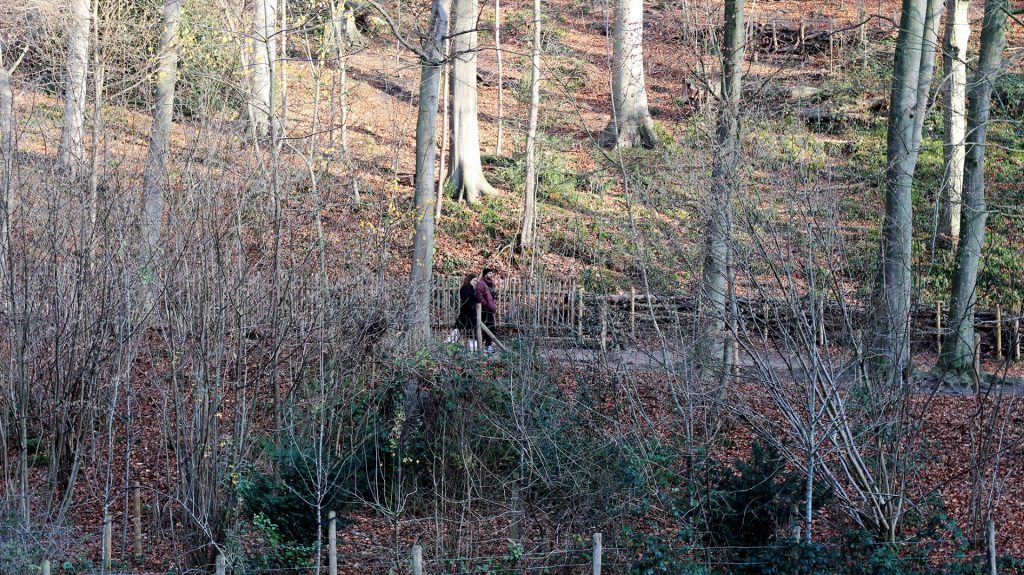
Paseo por vereda de tierra / Stroll along a dirt trail
Fotografía: Mariana Pinto
My first impulse was to consider changes to address these conditions. However, when I asked them about it, the participants mentioned that the very factors that undermine their perception of safety are the same conditions that promote the conservation of the local species they cherish so much. Besides being a public space, Duden is a natural conservation area. On this 24-hectare plot, it is common to see squirrels, rose-ringed parakeets, and crows, and during quieter hours, some foxes and bats.
That park users have to weigh the demands of adapting the park to improve their experience against the potential degradation of a unique urban forest ecosystem seems unacceptable and unnecessary to me. Mapping how we can explore better uses for parks like Duden, which are essential infrastructure for humans and more-than-humans, is a challenging but not impossible participatory process.
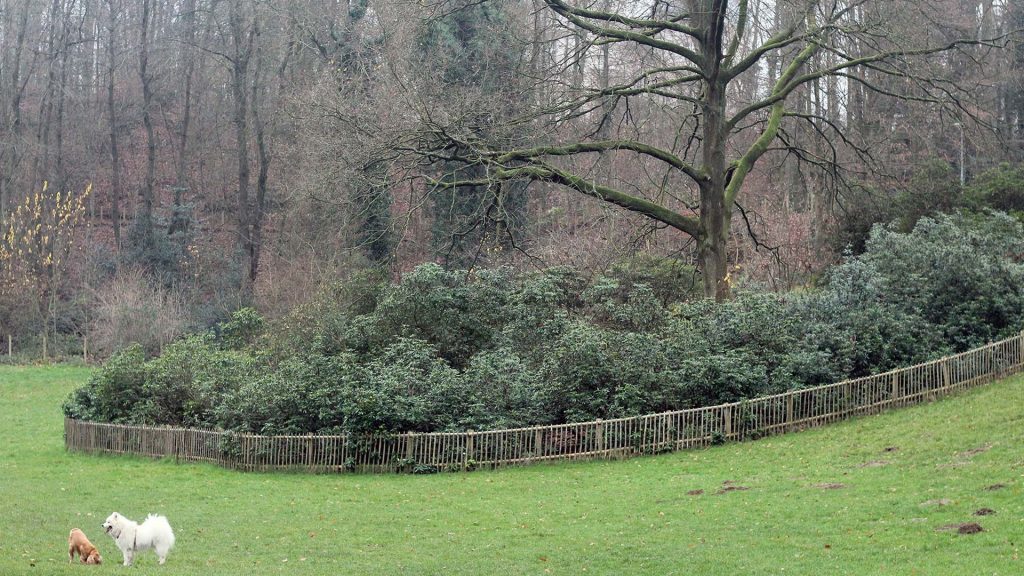
Árbol de castaño protegido / Protected chestnut tree
Fotografía: Mariana Pinto
Bibliografía/Bibliography:
Ingold, Tim. Culture on the Ground: The World Perceived through the Feet. Journal of Material Culture 9(3): 315–40, 2004.
Massey, Doreen. Space, Place, and Gender. Minneapolis: University of Minnesota Press, 1994.
Pink, Sarah. An Urban Tour: The Sensory Sociality of Ethnographic Place-making”. The journal Ethnography, Volume 9, Issue 2, pages 175-196, 2008. DOI: https://doi.org/10.1177/1466138108089467


-10.28.24.jpg "Anunciate07-13-a-la(s)-10.28.24")

 13.26.42.png "Captura de Pantalla 2023-02-08 a la(s) 13.26.42")