
From territory to oasis: Landscape, city, and life
In an interview with LANDUUM, Diana Hernández Lugo shares her experience in green infrastructure projects at SEDEMA in a conversation titled From territory to oasis: landscape, city, and life. She highlights the potential of the public sector to develop projects with lasting impacts through integrated, collaborative solutions supported by legal frameworks and social participation.
1.- From SEDEMA (Ministry of the Environment and Natural Resources), what has been the greatest technical challenge in trying to transform “residual spaces” into functional green infrastructure within such a dense city as Mexico City?
The greatest technical challenge has been understanding and addressing the city’s true complexity: its history, its hidden layers, and the accumulated decisions that, over decades, have disregarded basic natural processes. In a city like Mexico City, small omissions—such as sealing the soil or simply diverting water elsewhere—may seem insignificant in isolation, but when repeated systematically, they generate serious problems, such as flooding, traffic congestion, and the loss of habitability.
The challenge is not only to design, but to return to the root of the problem and, from there, propose comprehensive solutions that operate at the territorial scale, as a system rather than as isolated patches. This means questioning normalized practices, unlearning technical paradigms, and accepting something important: if we continue to make corrections without addressing the underlying causes, urban conflicts will persist. Transforming open spaces through green infrastructure requires thinking about ecological, hydrological, and social processes together, even when time or resources are limited.
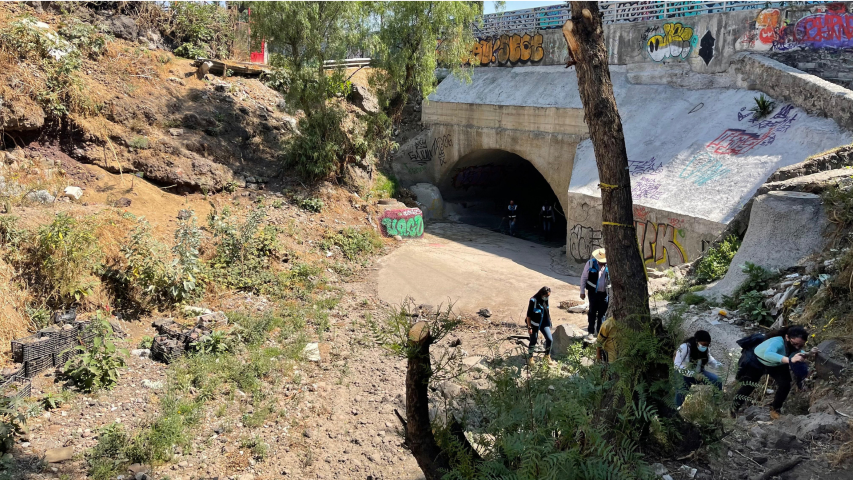
Río San Buenaventura, río intermitente con crecidas fuertes en época de lluvias. Tlalpan, CDMX/ San Buenaventura, an intermittent river with strong rises during the rainy season. Tlalpan, Mexico City.
Fotografía/Photography: Diana Hernández Lugo
2.-How can a landscape project survive changes in administration and become a long-term public policy, as in the case of the Special Program for the Green Infrastructure Network, Mexico City?
The key is for the project to be binding; in other words, it must be supported by a strong legal framework that establishes it as public policy rather than a discretionary action. When an instrument is established by law and has its own funding mechanisms, its continuity becomes much more viable, even in the face of changes in administration.
In the case of the Special Program for Mexico City’s Green Infrastructure Network (PERIVE), a key element was allocating environmental mitigation funds, channeled through the Public Environmental Fund and derived from environmental impact assessments. This made it possible to direct resources toward a portfolio of green infrastructure projects in different parts of the city, providing continuity and coherence to the interventions.
But there is something equally important: ensuring that citizens are aware of these instruments. When society understands how they work, people can demand their continuity, proper implementation, and appropriate use. The long-term sustainability of public policies depends not only on a solid legal framework and adequate resources, but also on civic participation and social oversight of the territory. And, ultimately, this is everyone’s responsibility: government authorities, academia, and citizens, with each contributing their part.
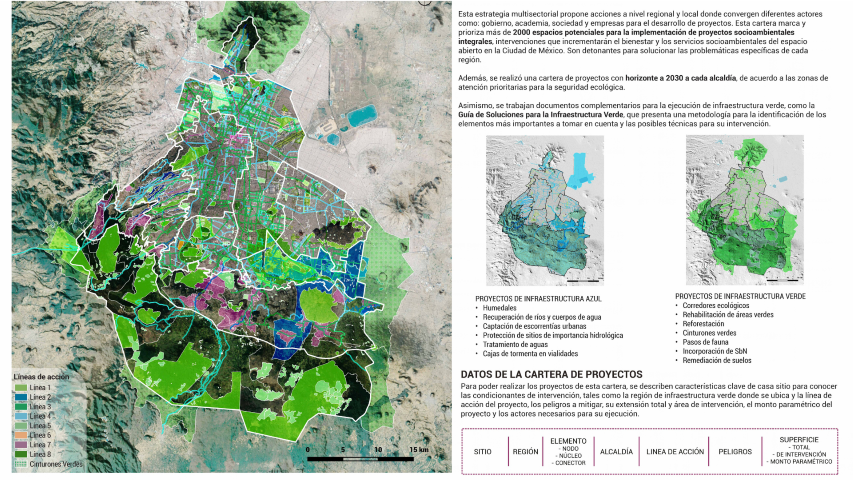
Cartera de proyectos PERIVE, horizonte 2050. Sedema-CDMX/PERIVE project portfolio, 2050 horizont. SEDEMA-CDMX.
Ilustración/ Illustration: Programa Especial de Infraestructura Verde de la Ciudad de México (PERIVE). Sedema
3.- In your experience with different green infrastructure projects, how would you define an “Urban Oasis”?‘?”
An urban oasis is a space that, even within dense or degraded contexts, maintains or recovers its capacity to sustain life, memory, and community connections, becoming environmental and social support for the city. It is not merely a physical space, but also a space of governance: its value is defined not only by the technical intervention, but by the way environmental, social, and cultural dimensions are brought together.
Something I learned while working in the public sector is that these spaces are not exceptional: they exist throughout the city, whether as Protected Natural Areas (PNAs), parks, Areas of Environmental Value, or simply as small oases that many people do not even know exist. During my time working for the Mexico City government, I had the opportunity to work in places such as the Sierra de Guadalupe and Sierra de Santa Catarina PNAs, Cuitláhuac Park, and Canal Nacional: spaces that are different from one another, but that share the ability to transform life in a place across environmental, social, urban, and even economic dimensions.
In the end, for me, it is a matter of governance rather than design: it is not imposed, but recognized, cared for, and strengthened. In most cases, the site already has a history of social appropriation and citizen demands. The role of design is to strengthen these existing dynamics rather than override them.
4.-For issue 37 of LANDUUM, we are exploring the concept of Urban Oases. What do you think is the “oasis” that Mexico City most urgently needs today?
It is a complex question. Mexico City is, in fact, made up of multiple oases, many of them invisible or undervalued. We find them in springs that coexist with residential areas; in rivers that become visible during the rainy season; in reservoirs that continue to play a key role in supporting biodiversity; in forgotten parks and forests; in the conservation land, with its particular characteristics in the north and south; and even in the old, hidden plazas of the Historic Center.
So, rather than thinking of a single oasis, what the city needs is to recognize, protect, and reconnect the ones that already exist; to understand their ecological and social value, and to stop seeing them as empty spaces or reserves available for urbanization.
The urgency lies in changing our perspective: understanding that these spaces sustain the city, and that caring for them is essential to our future. Today, from a broader national perspective, I continue to see that same pattern: every territory—whether a city, mountain range, or coastline—has its own oases to discover, protect, and strengthen.
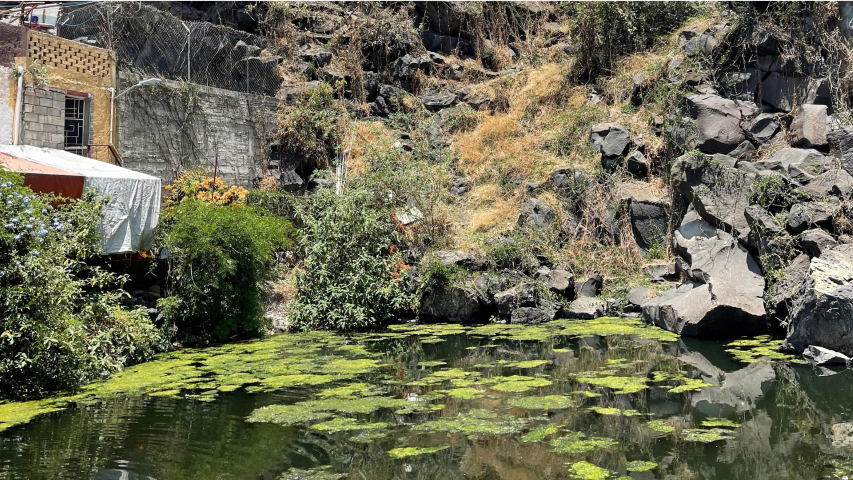
Manantial que convive con la vivienda. Ampliación Candelaria, Coyoacán, CDMX/ Spring coexisting with housing. Ampliación Candelaria, Coyoacán, Mexico City.
Fotografía/Photography: Diana Hernández Lugo
5.- As a National Autonomous University of Mexico (UNAM) graduate and a professional in the public sector, what advice would you give to new landscape architects who want to contribute to the transformation of the city through government?
I would tell them, above all, to learn to read, understand, and master regulatory instruments, and to look at them, precisely, from the perspective of the landscape architect: identifying within them the strengths that can later be translated into a project. Because that is where the policies are built that later become real interventions. The transformation of the territory by the government does not begin with design, but with planning, regulation, and management; and this applies both to urban and rural areas, each with its own logic and needs.
I believe that our training as landscape architects gives us something that makes us unique as planners and designers of spaces: the ability to act as bridges between the technical, environmental, and social aspects, and to always imagine what a space or territory could become. Every site, no matter how small or complex, can become an oasis if its context and potential are understood.
Having an impact from the public sector requires patience, strategy, and a broad vision of the territory, but it also offers an enormous opportunity to create real and lasting impact. And, on a more personal level, there is satisfaction in knowing that you are contributing to something good for our territories, our communities, and our planet.
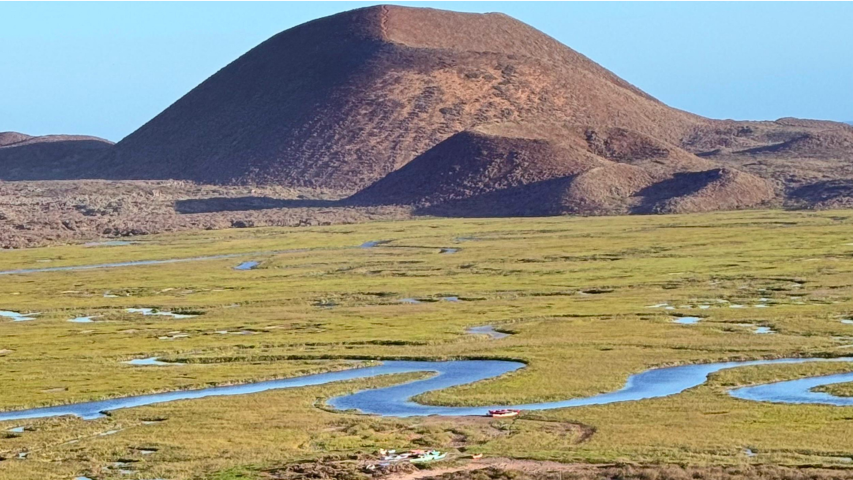
Humedal costero, San Quintín, Baja California/ Coastal wetland, San Quintín, Baja California
Fotografía/Photography: Diana Hernández Lugo
Author profile:
Landscape architect seek to understand the dynamics of the territory to design projects that bring society, nature, and landscape closer together and contribute to improving the functioning of the systems that comprise it.


-10.28.24.jpg "Anunciate07-13-a-la(s)-10.28.24")

 13.26.42.png "Captura de Pantalla 2023-02-08 a la(s) 13.26.42")