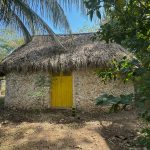

The oasis as method: reading territorial intelligence of Yucatán
In The oasis as a methodology: reading the territorial intelligence of Yucatán, Joseline Sierra Montero and Marwa Ridoini invite us on a journey through the history of the “oasis” concept to discover how the ancient Maya created spaces of balance and life that still defy time—teaching us an ancestral lesson in design and community that is more relevant today than ever.
The oasis as a territorial intelligence is a way of organizing life in relation to scarcity, distance, and collective survival that has operated for centuries: for 7000 years in the case of oases in the southeast of Morocco. What follows are extracts from it, a set of structural codes, a matrix that could be used for thinking about how we inhabit territory differently. Each code isolates one principle at work in the oasis and reframes it as a lens applicable elsewhere. There are ways of reading a territory and asking what logics, visible or buried, are making the territory.
1. Insularity
The oasis exists as a distinct world within a hostile environment. It is defined by its edges, its difference from what surrounds it. Code: It proposes un contretemps, un contre-espace1.
2. Network
No oasis survives alone. It exists within long-distance routes of exchange, trade, migration, and knowledge. Code: the network is a thinking system, a project. The possibility of designing networks.

Fotografía izquierda/ Left photography: Ícono de insularidad / Insularity icon
Fotografia derecha/ Right photography: Ícono de red / Network icon
Ilustraciones / Illustrations: Marwa Ridoini
3. Equilibrium
The oasis is a calibrated system — built form, water, agriculture production exist in precise balance. If one thing changes, the other elements have to adjust, or else the oasis will die. Code: every element of a settlement exists in conscience relationship to the others.
4. Commons
Resources in an oasis are collectively managed through negotiation. This governance shapes everything — architecture, clothing, learning, and social structure. Code: resource management is not only infrastructure, but it’s also culture.
5. Visibility
The water canals (seguia) run through the streets. The logic of the system is not hidden — it is legible in the everyday built environment. Code: a settlement should make its operating logic visible to its inhabitants.
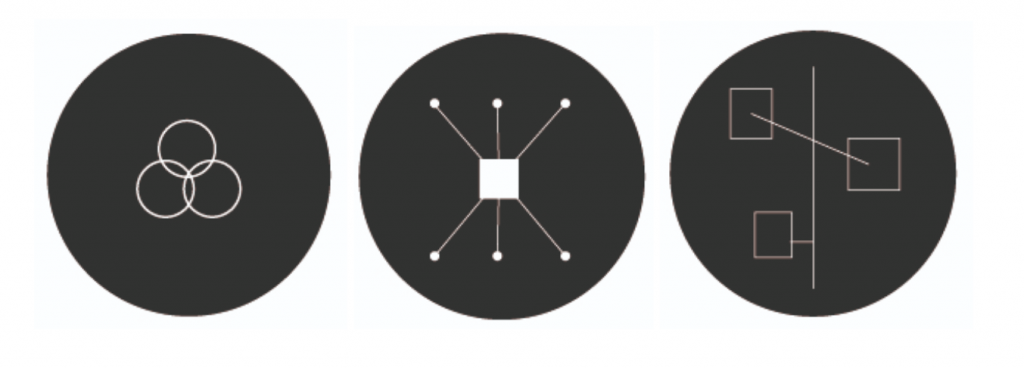
Fotografía izquierda/Left photography: Ícono de equilibrio / Balance icon
Fotografía central/Central photography: Ícono de comunes /Commons icon
Fotografía derecha/Right photography: Visibilidad: Sistema de canales de agua (acequias/seguia) que estructuran el oasis y hacen visible su funcionamiento / Visibility: A system of water channels (irrigation ditches/drainage canals) that structures the oasis and makes its functioning visible
Ilustraciones/Illustrations: Marwa Ridoini
Proposing une “reparation à l’habitation colonial through the oasis methodology of existing in the desert, Mexican Context.
In Historias del México agrario, John Tutino explains that Mexico functioned as an agrarian society from the beginnings of agriculture until the mid-20th century. Most people lived from subsistence, with surplus production supporting elites. This long-term condition produced territorial systems based on self-sufficiency, comparable to the logic of the oasis.
Pre-Hispanic Maya settlements were organized around this principle: a close relationship between habitation, agriculture, and cosmology. Like the oasis, they operated as balanced systems where resources, space, and social organization were interdependent.
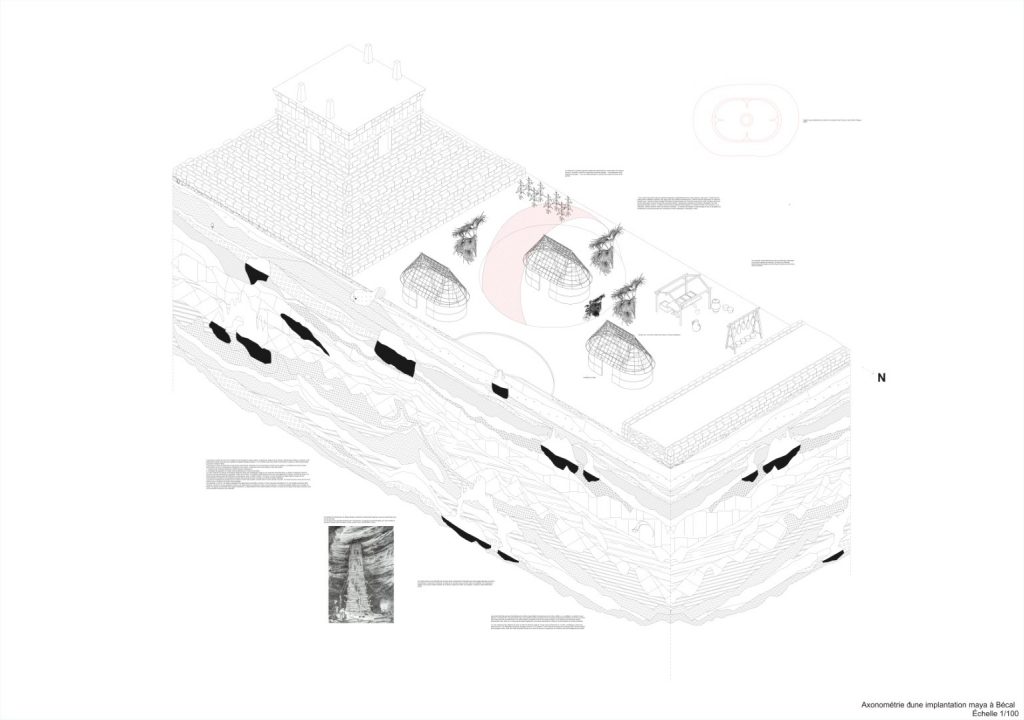
Oasis maya antes de la colonización / Mayan oasis before colonization
Ilustración/Illustration: Joseline Sierra
With the Spanish conquest, this system was transformed by the imposition of the grid, formalized through the Leyes de Indias. In regions such as Yucatán, where resistance was strong and prolonged, this transformation did not erase local practices but reconfigured them. As noted by Aldo Rossi, the destruction of existing faits urbains aimed at cultural replacement, yet in practice, adaptation prevailed.
At the residential scale, the introduction of solar, a standardized parcel within the grid, reframed this territorial logic. As studied by Javier Caballero, the Maya solar remained a productive and ecological unit, integrating agriculture, biodiversity, and daily life.
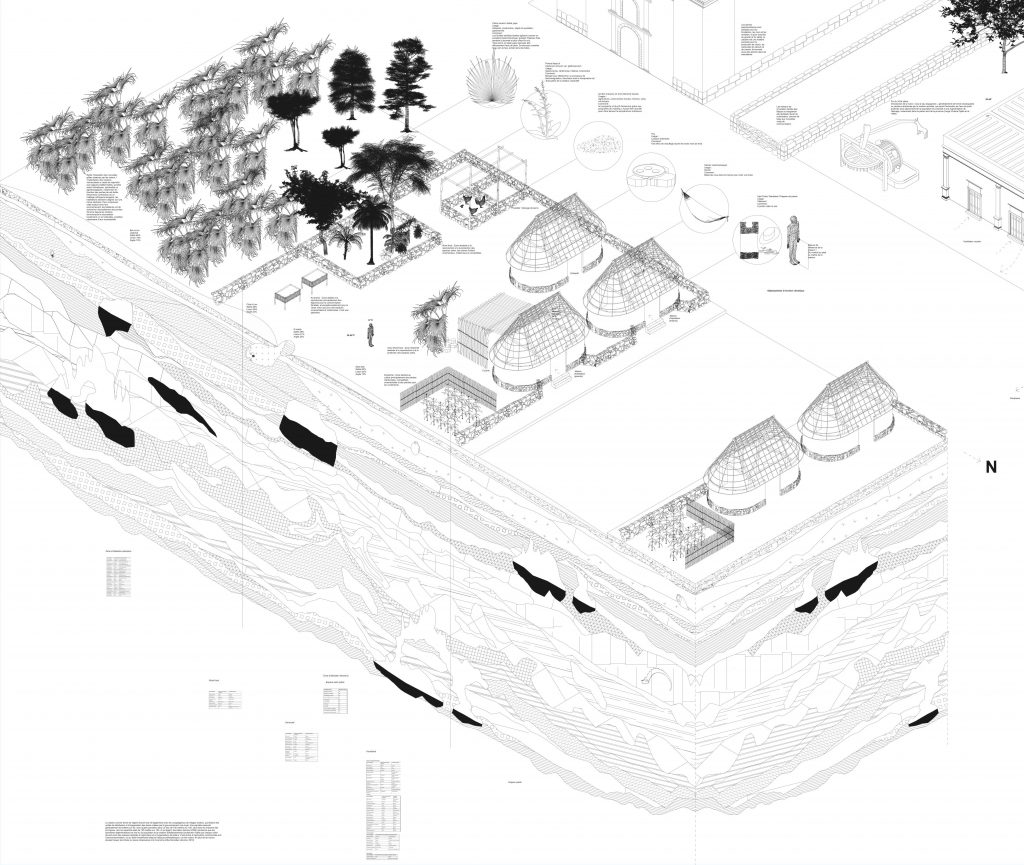
Oasis maya después de la colonización / Mayan oasis after colonization Ilustración / Illustration: Joseline Sierra
In this context, the oasis is suggested as an idea to think of alternative ways of inhabiting the parcel and the urban block. The configuration of buildings along the edges leaves a vegetated interior, maintaining a collective and productive landscape. This persistence of vegetation within the grid reveals the survival of a territorial intelligence rooted in balance, commons, and adaptation; core principles of the oasis.
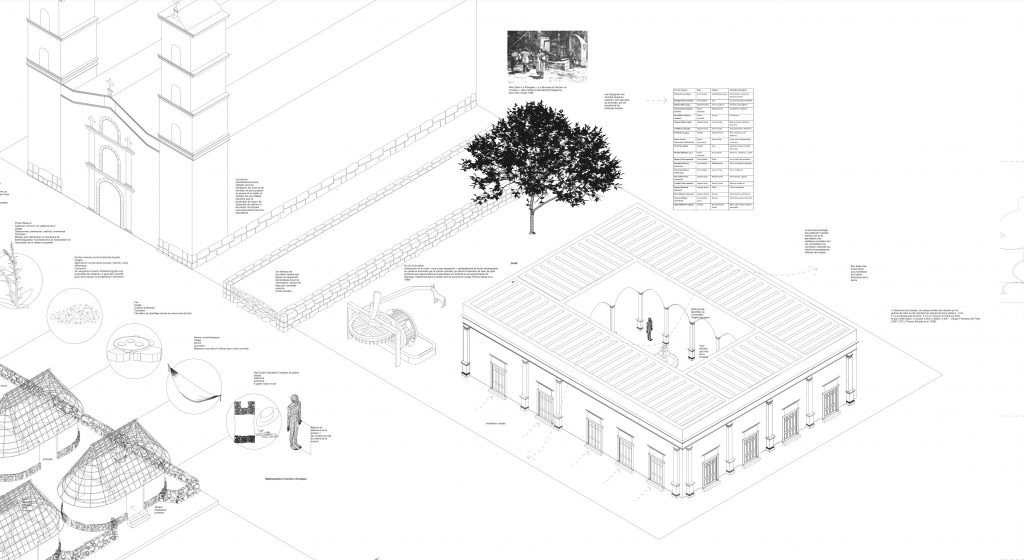
Funcionamiento del oasis maya después de la colonización / Functioning of the mayan oasis after colonization Ilustración/ Illustration: Joseline Sierra
The oasis as a geographical condition can be proposed as a conceptual tool. Its principles: insularity, network, equilibrium, commons, and visibility can be traced across different contexts, including colonial Yucatán. There, despite imposed urban forms, local practices adapted and survived, transforming the grid into a new kind of oasis at the scale of the solar and the block.
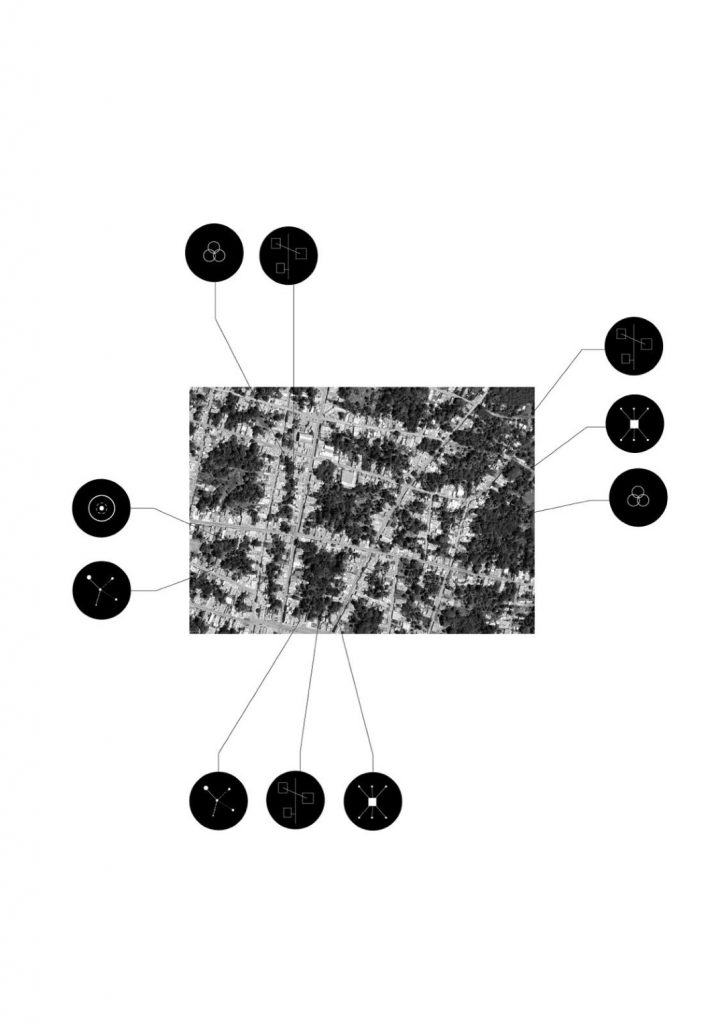
Metodología de oasis: interior de manzana en Yucatán con vegetación central resultado de la adaptación a la retícula colonia l/ Oasis Methodology: interior of a city block in Yucatán with central vegetation resulting from adaptation to the colonial grid
Ilustración/Illustration: Marwa Ridoini
Bibliography
- Caballero, Javier. “Maya Homegardens: Past, Present and Future.” In Tropical Homegardens, editado por K. Landauer and M. Brazil, 35–54. Tokyo: United Nations University Press, 1992.
- Foucault, Michel. “Les Hétérotopies.” Radio lecture, France Culture, December 7, 1966. Publicado en Le corps utopique, Les hétérotopies. Paris: Éditions Lignes, 2009.
- Foucault, Michel. “Des espaces autres.” Lecture at the Cercle d’études architecturales, 14 de marzo, 1967. Publicado en Architecture, Mouvement, Continuité, no. 5 (octubre 1984): 46–49. También publicado en Dits et écrits, vol. IV. Paris: Gallimard, 1994.
- García Targa, Juan. “Arquitectura colonial temprana en el área maya: registro material y documentación escrita.” 2006.
- LibreTexts. “The Decline of the Maya.” Consultado el 20 de marzo de 2026. https://human.libretexts.org/Bookshelves/History/World_History/Early_World_Civilizations_(L umen)/12:_Civilizations_in_the_Americas/12.06:_The_Decline_of_the_Maya.
- Maarouf, N. Lecture de l’espace oasien. Paris, 1980.
- Meunie, J.-D. Architecture et habitat de Dadès: Maroc présaharien. Paris: Librairie Klincksieck, 1973. Meunie, J.-D. Architecture et habitat de Dadès: Maroc présaharien. Paris: Librairie Klincksieck, 1973.
- “L’Architecture rurale populaire: tradition en péril.” Revue africaine d’architecture et d’urbanisme a + u (1967): 14.
Rossi, Aldo. L’architecture de la ville. Translated by Françoise Brun. Paris: L’Équerre, 1981. Tutino, John. “Historias del México agrario.” Historia Mexicana 42, no. 2 (1992): 177–204.


-10.28.24.jpg "Anunciate07-13-a-la(s)-10.28.24")

 13.26.42.png "Captura de Pantalla 2023-02-08 a la(s) 13.26.42")