

Pedestrian crossing at Plaza Mega Izcalli: an urban oasis between concrete and roots
The pedestrian crossing at Plaza Mega Izcalli: An urban oasis between concrete and roots, shows how Laura Heredi Lagos Bueno’s intervention transforms a car-dominated commercial setting into a small urban oasis. A gesture that turns a parking lot into a space where movement and lingering coexist, shade gains presence, and the pedestrian regains prominence.
Located within the Mega Izcalli Shopping Center, the central median faced a significant challenge: the natural growth of existing araucarias columnaris roots had created uneven surfaces, compromising the continuity and safety of pedestrian traffic.
Furthermore, the narrow strip between the planters and the parking area was insufficient, causing constant friction between pedestrians and vehicles. The space was purely functional—designed for crossing, never for lingering.
The intervention stems from a fundamental question: Can a crossing be transformed into a place?
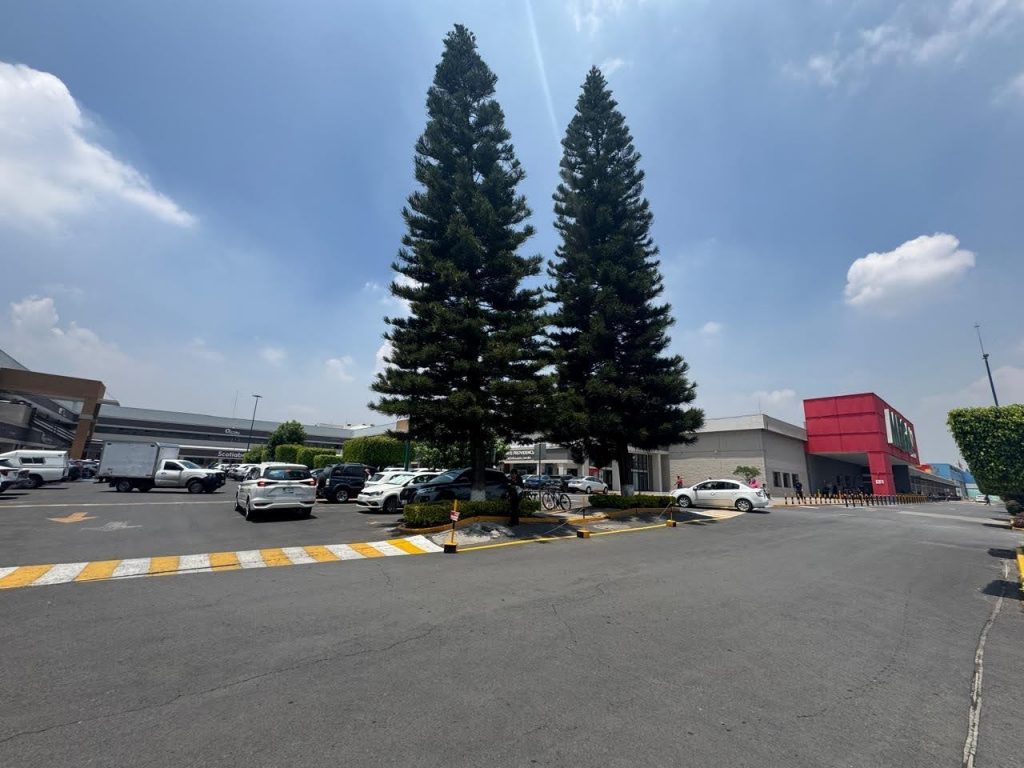
Plaza Izcalli antes de intervención / Plaza Izcalli before the intervention
Fotografía / Photography: Laura Heredi Lagos Bueno
The project redefines the pedestrian crossing as an accessible, habitable corridor that seamlessly integrates the shopping center, the roadway, and public transit access.
The new diagonal layout connects two previously disjointed ramps, establishing universal accessibility as the structural axis of the design. Circulation is no longer a residual byproduct of the site; it now holds hierarchy.
As the path winds through the araucarias columnaris grove, the pace of the city dilutes, giving way to a seating area—a conscious pause amidst the commercial flow. Here, the urban oasis truly emerges.
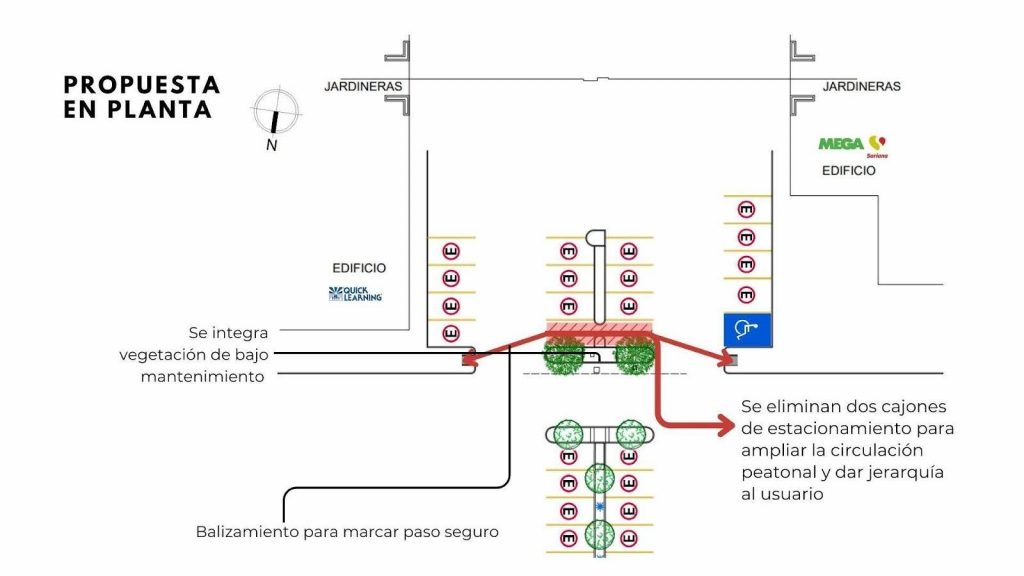
Planta propuesta de diseño / Site plan: design proposal
Ilustración / Illustration: Laura Heredi Lagos Bueno
Intervention strategy:
1. Circulation, accessibility, and dwelling.
- Two parking stalls were removed to expand the pedestrian realm.
- The diagonal path incorporates continuous ramps for people with reduced mobility.
- Horizontal floor markings (wayfinding) guide the journey and reinforce safety.
- The perimeter of the planters was reconfigured to allow root development without disrupting the pavement.
The intervention does not invade the roots; it enters into a dialogue with them.
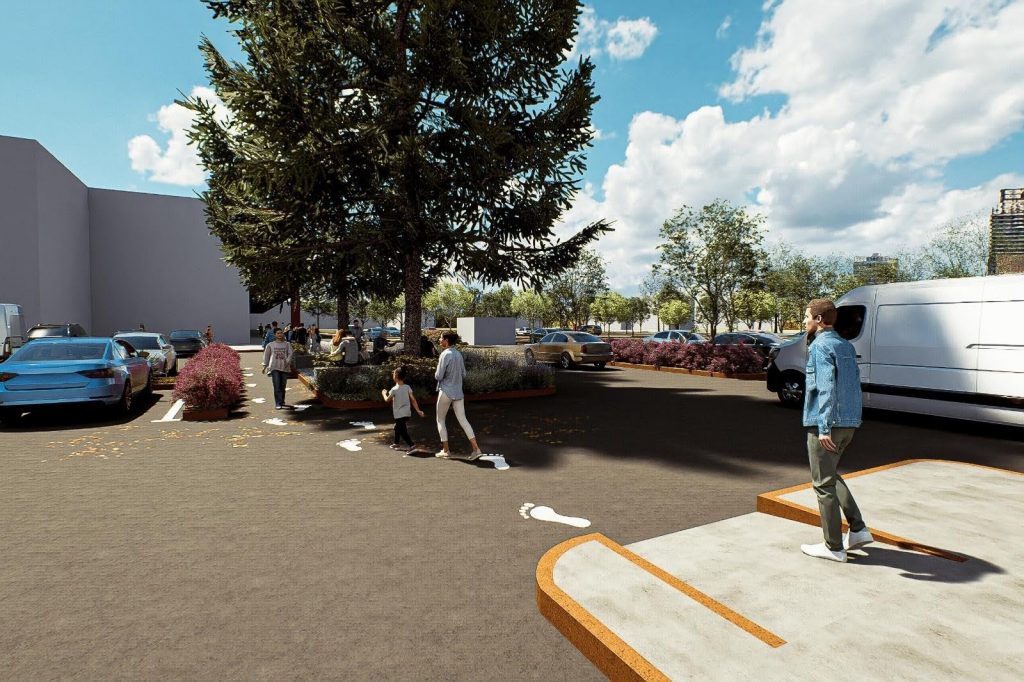
Render paso peatonal / Render pedestrian walkway
Ilustración / Illustration: Ricardo Valdés García
2. Sobriety and material durability. The project utilizes a resilient and minimalist aesthetic.
- Washed concrete was selected for its permeability, durability, and low maintenance.
- Monolithic polished concrete benches are integrated directly into the landscape.
- Non-slip edges and calculated slopes guarantee universal accessibility.
The hardscape does not compete with the vegetation; it frames it.
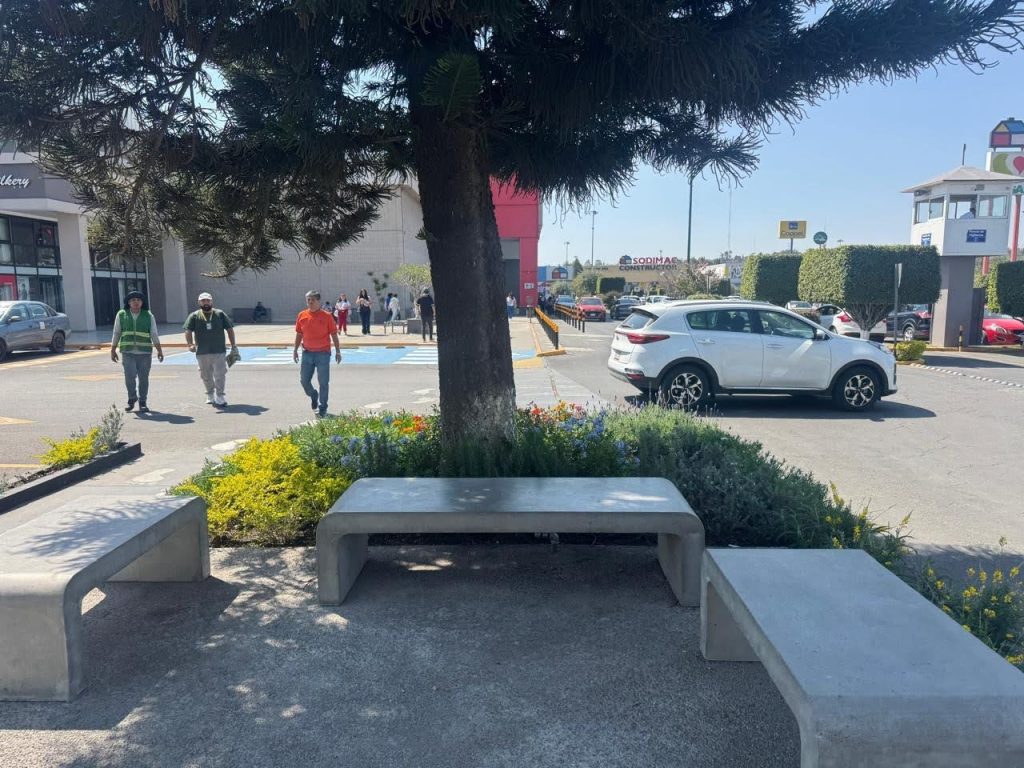
Zona de estar/Seating area
Fotografía/Photography: Laura Heredi Lagos Bueno
3. Vegetation as a microclimate. The landscape proposal transforms the crossing into a sanctuary.
By integrating low-maintenance, drought-tolerant species, the design adds texture, color, and thermal comfort. Groundcovers, herbaceous plants, and compact shrubs delineate the path without obstructing sightlines, while the existing pines provide essential shade and scale.
Where there was once conflict, there is now a pause.
The Plaza Mega Izcalli Pedestrian Pathway transforms a vulnerable junction into a safe, accessible, and vibrant space.
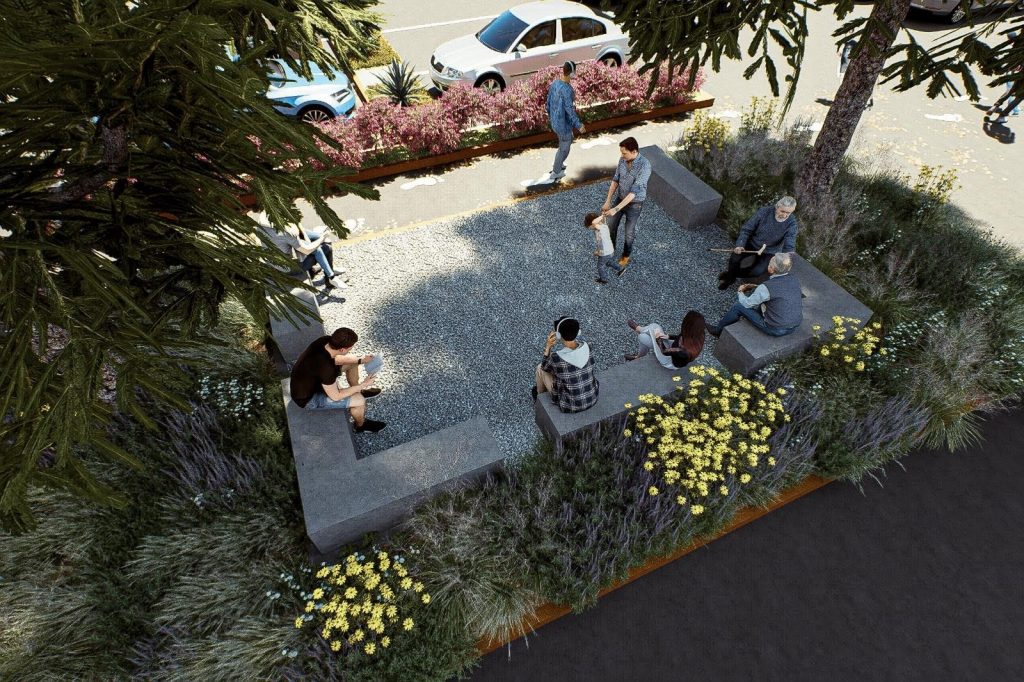
Render zona de estar / Render seating area
Ilustración / Illustration: Ricardo Valdés García
This intervention demonstrates that even in car-centric commercial environments, it is possible to cultivate small urban oases: places where mobility and dwelling coexist, where concrete meets shade, and where the pedestrian finally regains the leading role.
It is more than a path. It is a green breath within the daily rush.

Zona de estar / Seating area
Fotografía/Photography: Laura Heredi Lagos Bueno


-10.28.24.jpg "Anunciate07-13-a-la(s)-10.28.24")

 13.26.42.png "Captura de Pantalla 2023-02-08 a la(s) 13.26.42")